I have gotten this question from a Project Manager; “How do you handle multiple projects and how many is too many?”
I’ve heard an old old story about a farmer who was trying to save money on food for his horse. He fed the horse a little less every day. It was a working horse, pulling heavy loads.
It was going along so well, that farmer got the horse down to a handful of feed a day, cutting his costs on feed. Then the horse died. The farmer was angry because he couldn’t finish his experiment.
Business loves to save money. Me too. But that poor horse!
How many projects can one PM manage at once?
It depends. And I hate that answer. As a PM, I gather the team at the internal kickoff to make sure we have the right resources to get the job done. I will raise a red flag, even calling a halt if I see we don’t have what we need. I won’t sent the team onsite without enough people. If I see some guy trying to be a superhero and lift a display alone, I stop him and insist we get another person.
I don’t want to lose a critical resource to injury. I’ve been known to ask the client to provide an extra set of hands if they can’t afford to pay for another person.
When the bosses do the WIP report, who is checking on the load the PMs are carrying?
I’ll be honest, I’ve been that one carrying too much in the past.
There was that time that I didn’t double check the delivery address on a shipment of touchscreen displays and they all went to one address instead of the 7 different places it was meant to go to. I felt bad about that, but on the other hand the manager who handed me the project did not make it clear when he assigned me the project.
Those managers of project managers are caught in the middle. PMs are expected to do their job and not bring attention to themselves by talking about problems.
A good PM knows that risks need to be exposed as soon as possible. We stay aware of weather that would delay deliveries to site. We must make sure that everyone on the job has what they need. It’s big waste if they don’t.
There is an old saying in project management. You can’t take three pregnant women and set them to work to produce one baby in three months.
Some things take time. We know how long it takes to gestate a baby.
When it comes to managing a project, it’s a road less travelled. I don’t know the map. The project management institute defines a project as an effort that produces a UNIQUE result.
Definitively, we don’t know exactly how much work it’s going to take and how long it’s going to be.
So those middle managers—the bosses over the project managers—hand out the projects with a hope and a prayer. If the PM fumbles the project, it’s the manager’s fumble just as much as the PM, because he’s the one who chose you to do this work.
Did he misjudge how much work that project was going to be? That’s when the PM has the responsibility to raise the alarm.
Yep.
That means I have to say “This is too hard for me. I need more time.”
And I have to say this humiliating thing to my boss.
That boss who made assigned it to me. If he had somebody better standing by, he probably would have given it to that person. Maybe his favorite PM already told this boss that HE is overworked. And I—the rookie who screwed up the delivery of 7 displays—want to come to him with the same complaint.
Whose job is on the line?
Everybody has something to worry about.
I better be very very very sure before I say it.
Which means:
Double checking everything, looking for ways to expedite or shuffle the tasks
Late nights
Early mornings
Lunch at the desk
Telling my family I’m busy and I can’t
The clock is ticking, pushing me and the project to the brink, to the point of failure.
I can do this. Just barely. Don’t miss that phone call or that shipment or the next meeting.
Then the boss gives me another project because I’m doing so well on the ones I have.
I never said otherwise.
And I’m proud that I didn’t have to fold. I’m getting better at this. I wonder how many more projects it will take to be that favorite PM. The one who was able to say he were too busy for another project.
It’s not just me. The whole project team is working on the brink. Some of the best programmers and commissioners working so many hours that they quit to get a break.
The PMs have tools in their kit. They control—well, steer—the schedule. Some projects can be sped up a little, others can be delayed because of resources. If I’m good, I can push out a task for day so I can go to my kid’s musical performance. And often I go but still wrestle a flood of texts while in the audience.
To mix up the metaphors from earlier, I am the underfed pregnant horse trying to pull the load I’m given.
What’s the right answer? Can I be confident that I know enough to recognize when the load is too heavy? Would my boss even believe me?
Deep breath. My job is to manage the project.
I know how to do this.
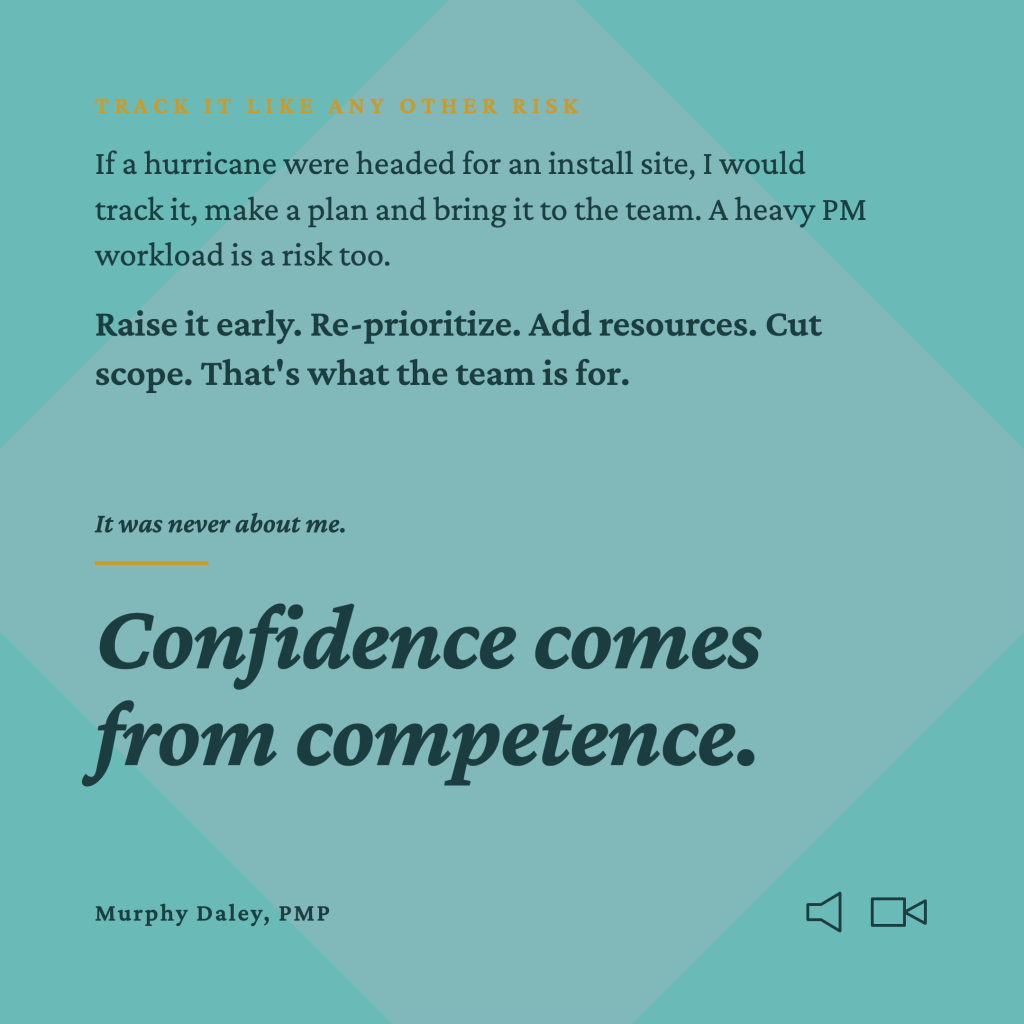
When I identify a risk, I need to track it. If a hurricane were coming to an installation site, I would tack it and come up with a plan. We would bring it up in the team meetings.
If a heavy PM workload is a risk, I need to track it the same way. As early as I see it, I can bring it up and say that things might get delayed and I will keep them updated. The team can huddle to re-prioritize the tasks. Some things could be delayed. More resources can be added if the timeline can’t slip. Scope could be cut.
All these risks and mitigation can be tracked, and the team is working together. That’s what the team is for.
That documentation I create from the team is what gives me the confidence. Bringing up the risk early is about the success of the project. Not about me.
It was never about me.
I don’t want to make another rookie mistake by trying to do it all alone. When the project work mounts, I can track that risk just like any other. This protects the project and builds a protection for me.
I don’t know if I’m ever going to be my boss’s favorite. I do know I can give status updates on my projects, including the workload to whole way along. Confidence comes from competence. That’s the part I can control. That’s what I know.
Leave a Reply